
Auburndale · Restoration
Restore or replace: deciding what to do with a tired in-town drain field
Ask two contractors about a struggling drain field and you can get two different answers before either one has picked up a shovel. One says it can be saved. The other says it has to go. Neither has seen the soil. On the older homes around Auburndale’s lakes and old downtown, that decision is worth getting right, because a field that could have been restored is a costly thing to replace by mistake. The answer comes from digging, and from knowing what the yard was telling you first.
What the yard and the drains say first
Drain fields rarely quit overnight. They send signals, and most owners notice one or two without connecting them.
Grass over the field that grows greener and spongier than the rest of the lawn is a common early one. So are drains that get slower in wet weather and recover when it dries out. A septic smell outside, especially on warm, damp days, belongs on the list too. Water that stands over the field after a rain, long after the rest of the yard has drained, is a louder warning.
Sandy topsoil around here usually takes rain quickly. Ground over a field that stays wet when everything around it has dried is telling you something other than weather.
Write down what you notice and when, and snap a few photos. Texted pictures speed up the diagnosis. Waiting does the opposite.
Pumping the tank comes first
Every drain field visit starts at the tank. It gets pumped and cleaned, and while it is open Jacob looks at what is inside and how it has been working.
The sludge layer gets measured. A tank that was carrying far too much sludge has likely been pushing solids out toward the field. The outlet gets a look too, along with how the water level sits and whether anything is flowing back from the field side when the tank is drawn down.
Sometimes pumping alone changes the picture. A tank that was badly overdue gets emptied, the field gets a rest, and the symptoms ease. A damaged field stays damaged after a pump-out. Still, the breathing room is useful, and how the field responds says a lot about how much life it has left.
If the field is going to be restored, expect a quieter house for a while. A rested field recovers faster when the laundry gets spread across the week instead of six loads on a Saturday. Leaky toilets and dripping faucets get fixed first, because a running toilet sends water to the field around the clock while everyone is asleep.
Either way, the tank has to be right before anything done to the field will last. Most homes in Polk County do well pumping every three to five years. The older in-town tanks deserve a look more often, every three or four, and an addition that brought more people into the house is a good reason to lean toward the short end. The measured sludge layer gives you an interval for your own tank, which beats any postcard schedule.
Dig it up and look before deciding
Guessing is how people end up paying for the wrong fix. So the next step is exposing the field in a few places and looking at the lines and the soil around them.
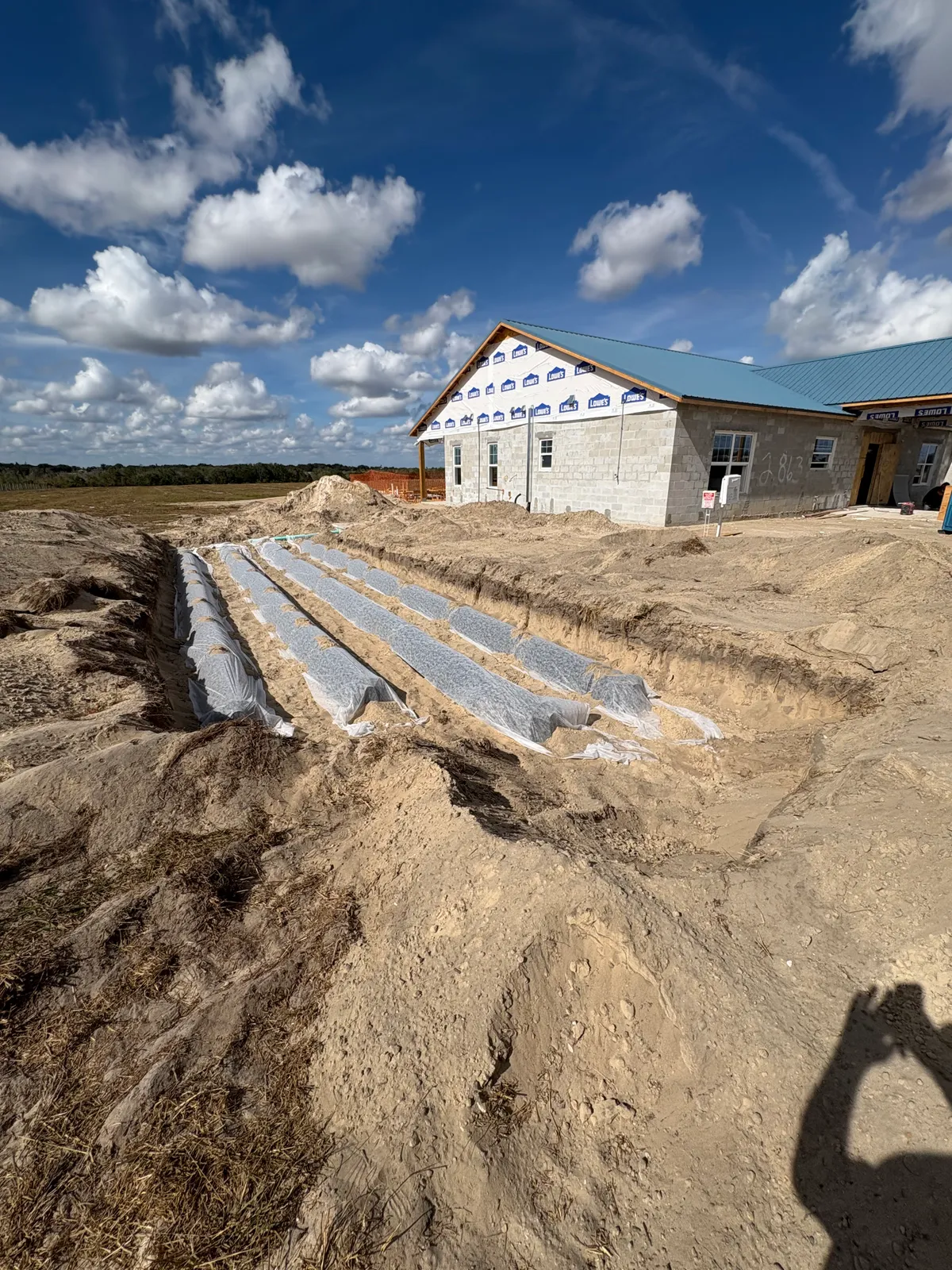
Exposing a field does not mean tearing up the yard. A few test holes along the lines are usually enough, each one opened, looked at and backfilled the same day. You can stand at the edge of the hole and see what Jacob sees: the color of the sand, whether a black mat has built up around the gravel, whether water seeps back in as fast as it is bailed out.
If the sand around the lines still takes water and the trouble is buildup inside and right around them, restoration is on the table. That work aims to bring the existing field back into service without tearing out the whole thing.
If the soil around the lines has sealed up, stays saturated and will not take water no matter what, the field is done. Patching it just delays the next failure. At that point a replacement field is the real fix, designed fresh and permitted with FDOH in Polk County.
Roxann Bonta’s Google review says it well: Jacob “fixed the issues and educated me on my septic system.” You see what we see in the hole, and the decision makes sense to you before any money is spent on it.
Lake-area fields and life after the repair
Homes near Lake Ariana and Lake Juliana add one more factor. When the lakes are up in the wet season, there is less dry sand under the field to treat effluent. A field near the lakes can look worse in the rainy months and better in the dry ones for that reason alone. Any repair or replacement there gets planned around elevation first.
Once the field is working again, protecting it is mostly the owner’s job, and the biggest piece of that is the tank. An overdue pump-out is how most of these fields got into trouble in the first place, so the interval Jacob gives you from the sludge measurement is the one to keep.
The full rundown on field work in town is on our Auburndale drain field restoration page. If storm water is soaking your field, the land grading page covers moving it away, and finished jobs are in the gallery.
Old field questions
Can an old drain field really be restored?
Often, yes, if it is caught early. When the sand around the lines still takes water and the trouble is buildup, restoration can bring the field back into service. When the soil has sealed and stays saturated, the field is finished and needs replacing. Digging and looking at the lines and soil is the only reliable way to know which you have.
Why do my drains get worse every rainy season?
Wet weather leaves less room in the soil under the field for effluent to go. A healthy field handles that. A struggling one shows it first in the rainy months, with slow drains that recover when things dry out. Near the lakes, high water in the wet months adds to it. Either way, it is worth getting the field checked.
What is the probe telling you when you work it down a line?
Where the effluent is standing. A probe pushed into the ground along a line comes up wet or dry, and the pattern tells the story. Wet near the tank and dry farther out usually means the first lines have been doing all the work. Saturated from end to end points at a field that has sealed.
Field acting up on an older house?
Text Jacob a few photos of the yard over the field. He pumps the tank, digs to see what is really going on and puts a price in writing on the fix that fits.