
Haines City · Drain Fields
The four things that actually end a Haines City drain field
Drain fields do not die of bad luck. On Polk County sand we dig up the same four causes over and over, and they do not look alike, move at the same speed, or call for the same response.
Here is what actually ends a field in Haines City, how fast each one works, and what it leaves at the surface for you to read.
Biomat, the one that was always coming
Every field builds a biomat. It is a thin, dark, living layer that forms where effluent meets soil in the trenches, and in small amounts it earns its keep by slowing water enough for the sand to treat it. It also never stops growing. Trench bottoms that once took water freely start behaving like a sealed pan, which is not a failure of care. It is how a field reaches the end of its working life.
What you control is the speed. A tank pumped on a sensible rhythm sends mostly clear liquid to the trenches. A tank left far too long stops holding solids at all, and grease and sludge ride out and thicken the mat far faster than effluent alone would. Nearly every black cap we peel off a trench bottom traces back to a tank nobody had touched in years.
Compaction, the one you cannot undo
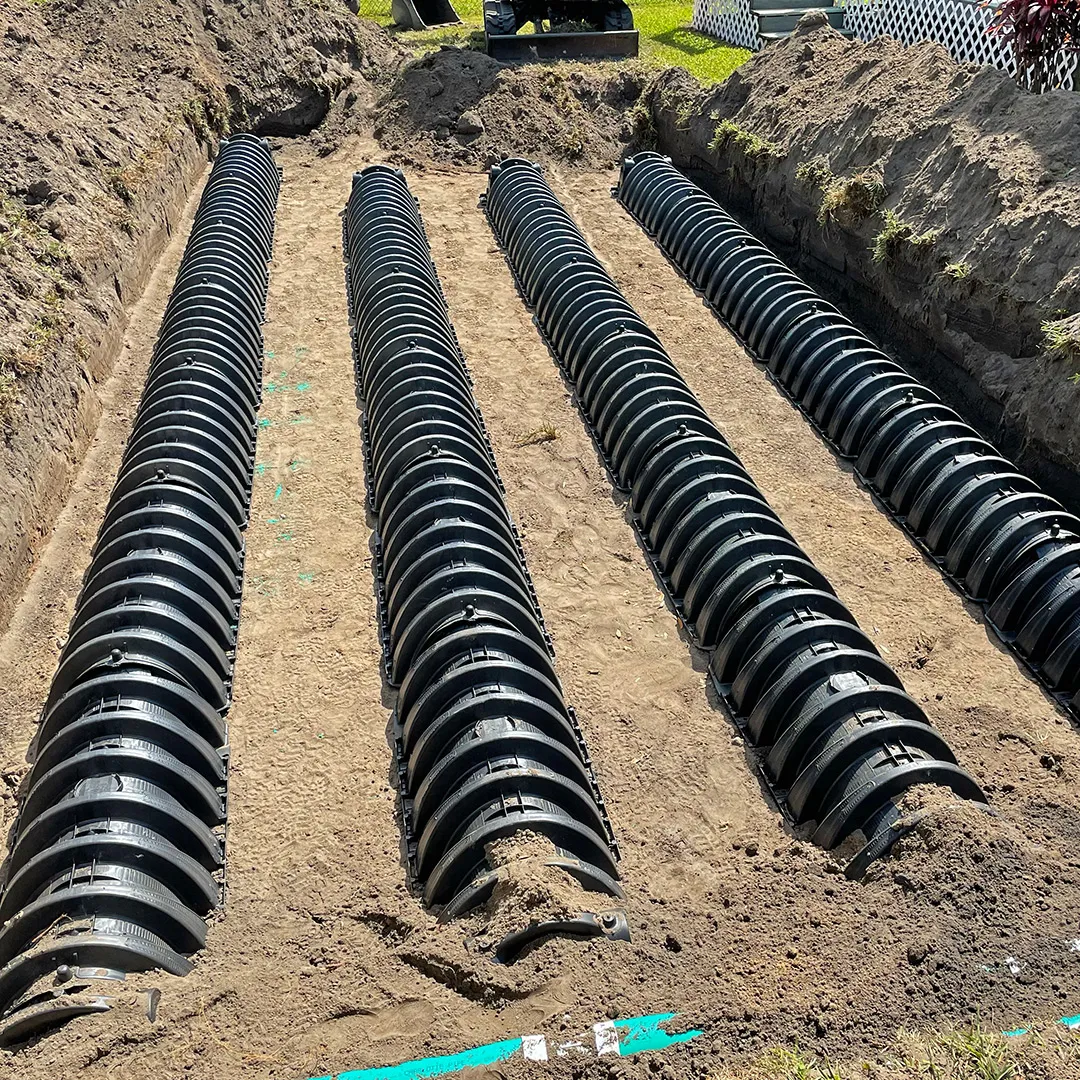
A field works because the sand around the trenches has structure: small voids that water moves through and air reaches. Weight closes them. A truck parked over the lines, a trailer left on the grass all season, a shed on blocks, a pool deck poured across the field. The sand is still there. The space between the grains is gone.
This is the fast one. A loaded truck crossing soft ground after a rain does in one afternoon what biomat needs years to accomplish, and it can crush the perforated lines on the way. You can pump a tank, cut roots and move water. You cannot un-press soil. Compacted ground gets replaced rather than rescued, which is why parking and structures are the first questions we ask.
Roots, an invasion rather than an event
The older core of Haines City has real trees, and mature oaks are what we find in the lines. Roots are not hunting your pipe. They follow moisture, and a drain field is the wettest ground on the lot, so they grow toward it and keep going. Fine roots slip through the perforations, thicken inside the pipe, and turn one line into a plugged mess a season at a time.
That pace is why roots surprise people. Capacity narrows a little each year until the field cannot take a normal Sunday of laundry, and by then the root mass has been building a long while. Newer subdivisions on the edge of town do not have this yet, though the oaks planted at closing are headed the same way.
Hydraulic overload, more water than the field can accept
A field is sized for a certain amount of water a day. Send more than that consistently and it fails no matter how healthy the sand and the mat are. The causes are ordinary. Kids grow up and the household doubles its showers. A flapper leaks all day and nobody hears it. A downspout aims a roof of rain at the trenches, or the yard grades so storm water runs to the low spot the field sits in.
Add our wet season to that. From June into September the water table comes up on its own, so the field has less room underneath it to begin with, and a house that got away with heavy water use in the dry months finds its limit in July. Overload is the one you can reverse, if you catch it before the field seals or drowns.
Reading your own yard
None of the four leave the same mark, so the surface gives you a fair guess before anyone digs.
- Biomat: the whole field softens at once, grass greener over the lines, drains that slowed gradually rather than overnight.
- Compaction: trouble shaped like tire tracks, a wet stripe right where the trailer sat, timing that matches whatever was parked there.
- Roots: one trench quits while the rest hold, and the wet ground sits on the tree side of the yard.
- Overload: the field looks fine in the dry months and surfaces whenever the house is full or the rain sets in.
What additives do not do
Somewhere in this someone suggests pouring a jug of something down the toilet to restore the field. It will not. Every problem above is physical: a mat plugging the interface between pipe and soil, or crushed sand, or roots, or too much water. Nothing that fits down a drain reaches the trench bottom in a form that removes any of it. A working tank already has the bacteria it needs. What a field needs is the solids kept out, and that is a pump truck.
What genuinely buys a field more time
The list is short and none of it is complicated.
- Pump on a rhythm that matches the house instead of waiting for a problem. Every pump-out is solids that never reach the trenches.
- Keep the weight off. Mow it and walk it, and park vehicles, trailers and sheds somewhere else.
- Send water elsewhere. Extend the downspouts past the field and grade the yard so storm water runs away from the trenches.
- Spread the load. Laundry across the week rather than six loads Saturday morning, and fix the running toilet the week you notice it.
Plan for it instead of finding out in August
Good habits change how long the clock runs. They do not stop it. The homeowner who knows roughly where the field stands picks the timing. The one who does not meets the problem in the middle of the wet season.
If your field is showing early symptoms, find out which of the four you have while options still exist. A drain field restoration is a real answer for a field that is clogging and a poor bet for one that has been crushed or drowned, and we will tell you which yours is, standing in your yard. Any repair or replacement also has to satisfy the Polk County health department, so their office is the one to ask about what is allowed on your lot.
You can see how we handle work around Haines City , and if you would rather have the yard read than guessed at, get us out there before the rain decides for you.
Haines City drain field FAQs
Which of the four do you find most often in Haines City?
Biomat, by a wide margin, usually sped up by a tank that went too long between pump-outs. Compaction is second, on lots where a trailer or a truck lives on the grass.
Can a compacted drain field be repaired?
No. Once weight has pressed the structure out of the sand, nothing puts those voids back. That field gets replaced, which is why we are strict about parking.
Will taking down the oak save the trenches?
It stops new growth toward the field, but roots already inside the pipe stay there and have to be dealt with. Removing the tree helps most before a line plugs completely.
Do additives help a field at all?
They do not solve any of the four causes. A healthy tank already carries the bacteria it needs, and nothing poured down a drain removes a sealed mat, compacted sand or roots.
How do I plan for a replacement instead of getting surprised by one?
Have the system looked at while it still works, ask where the field stands, and get the answer in writing with a firm price. Knowing the work is coming beats finding out on a Saturday in August.
Wondering how much life your field has left?
Get an honest read on which of the four you are dealing with, and a firm written price from the owner.