
Haines City · Drain Fields
Why your Haines City septic backs up in August and behaves in March
A septic system that runs fine in March and backs up in August did not usually break in August. It has been running on a thinner margin than you knew about, and the wet season took that margin away. Around Haines City we get this call in the same few weeks every year, and the repair almost never starts where people think it does.
Here is what is happening under the yard, why the first assumption sends most people down the wrong road, and how to tell a seasonal problem from a field that is done.
A drain field works by handing water to the soil
The tank is only the first half of the system. It holds solids and lets liquid move on. The second half, the drain field, is a run of perforated lines laid in gravel or chambers a couple of feet down. Treated water leaves those lines and soaks into the soil beneath them, where air pockets in the dirt finish the treatment. That soaking is the entire job. If the soil below cannot take water, the field cannot take water, and everything upstream backs up toward the house.
Now add the seasonal water table. In this part of Polk County the ground water sits low through the dry months and climbs through the summer rains. When it rises to meet the bottom of the field, the soil that was supposed to be receiving your water is already full of somebody else’s. There is nowhere for the water to go, so it stays in the lines, then in the tank, then in the slow drain in the back bathroom.
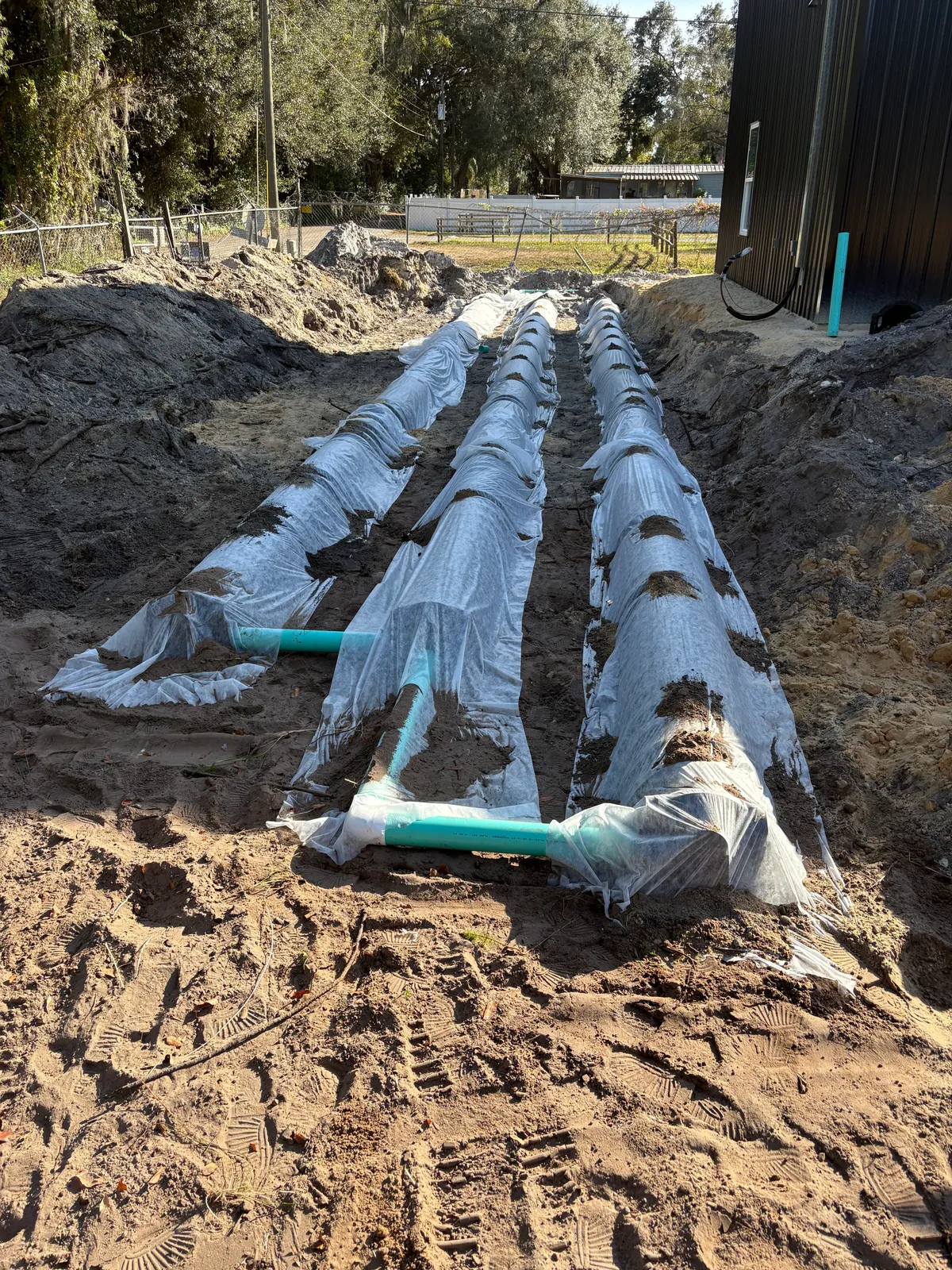
This is capacity, not a clog
That distinction matters more than anything else here. A clog is a blockage in a pipe. What happens in August is the opposite: the pipes are open and the ground is full. So the usual first move, snaking a line or hunting for a root, finds nothing, and people spend two weeks and real money proving the plumbing is fine. The plumbing was fine. The soil ran out of room.
You can usually hear it in the timeline. A clog shows up on a random Tuesday and gets worse until somebody clears it. A capacity problem arrives with the weather, eases when a dry week comes through, and returns with the next stretch of afternoon storms.
The sandy soil paradox
Sandy soil around Haines City drains beautifully. Rain disappears off the surface, puddles are gone by dinner, and nobody pictures water sitting anywhere. That reputation is the trap. Drainage speed and vertical room are two different things. What a field needs is unsaturated soil between the lines and the water table, and on plenty of ground out here that separation is thinner than the sand suggests. The water moves fast, and it does not have far to rise before it is up in the trench zone.

Saturated for the season, or genuinely finished
This is the question worth paying to answer, because it decides whether you are managing a system or replacing part of one. A seasonally saturated field recovers. Come November it drains, the wet spot dries, the house runs normally, and the whole thing acts like it never happened. A failed field does not recover. It stays soggy through the dry months, the grass over it holds a different color year round, and the tank refills within a day of being pumped even in February.
Reading that correctly takes some history, which is why we ask when it started, how long it lasts, and what the yard looks like in the dry season before recommending anything.
What is in your control
You cannot lower the water table. You can stop adding to it:
- Roof runoff aimed at the field. Downspouts and gutter lines that dump near the trenches are the most common one we find, and the cheapest to correct.
- Irrigation zones running over or beside the field through the same months the rain is already soaking it.
- A week of heavy laundry during a wet stretch. Four loads in a day is a lot of water going into ground that has none to spare, and spreading it out costs nothing.
What pumping does and does not do
Pumping during a wet season backup is not wasted. It empties the tank, and an empty tank gives the house somewhere to put water for a few days while the ground dries. That is real relief, and sometimes it is what gets you through a weekend. What it does not do is change the soil. The field is still saturated, the tank refills as the field pushes back, and you are in the same spot by the end of the week. Pumping monthly all summer buys days. It does not fix anything.
Warning signs, in order of how much they matter
Roughly least serious to most:
- Drains that slow down during a rainy stretch and clear up when it dries out.
- Gurgling from tubs and toilets when the washing machine drains.
- Brighter, spongier grass over the field that outlasts the rain by a couple of days.
- Odor outdoors near the field after heavy household use.
- Standing water over the trenches, or sewage backing up into the lowest drain in the house. Stop running water and call.
A field that floods every wet season is telling you something
One bad August behind a stalled tropical system is weather. Three Augusts in a row, each starting earlier and lasting longer, is a field near the end of its useful life. That does not mean tearing it out this month. It means knowing where you stand, so the work becomes a plan with a firm written price instead of an emergency in the middle of a storm. We will walk it and tell you which one you have, whether that points toward drain field restoration or ordinary septic system repair work. You can also read how a full Haines City job runs from the first call, and if permitting enters the picture, the Polk County health department is the office that says what applies to your property.
Haines City wet season septic FAQs
Why does my septic only back up in the summer?
Because the problem is the water table, not the plumbing. From June into September the ground water climbs toward the bottom of your drain field, so the soil that normally absorbs your water is already full. The system did not change. The room underneath it did.
Is a wet season backup a clog?
Usually not. Clogs show up on a random day and stay until someone clears them. Capacity problems arrive with the rain, ease during a dry week, and return with the next storms. If the timing tracks the weather, start at the field, not the pipe.
Will pumping the tank fix it?
It helps for a few days. An empty tank gives the house somewhere to put water while the ground dries, which is worth doing when you are backed up. It does not lower the water table, so the field refills the tank and the relief is short.
How do I know the field is finished and not just wet?
Watch the dry months. A seasonal field recovers by late fall and behaves all winter. A finished field stays soggy in February, keeps a differently colored patch of grass year round, and refills the tank within a day of pumping. That second pattern is a replacement conversation.
Does sandy soil not drain well enough to prevent this?
Sandy soil drains fast, so surface water vanishes and everyone assumes there is plenty of room below. Speed is not the same as depth. If the separation between your trenches and the seasonal water table is thin, fast soil still runs out of room in August.
Backing up again in Haines City?
Get a straight read on whether the field is seasonal or finished, from the licensed owner who does the work himself.